Wilson · teardrop shape
Blade LS v4
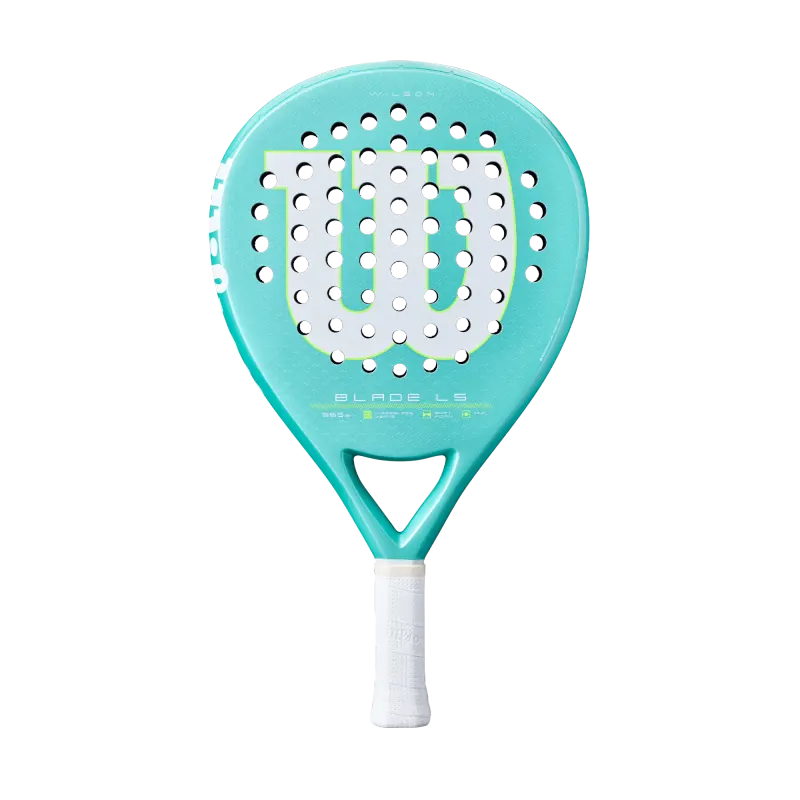
- Weight
- 355 g(per store)
- Balance
- Medium(per store)
- Shape
- Tear Drop
- Hardness
- Soft(per store)
The dashed lines mark the sweet spot, where the ball comes off clean and with more power: on a teardrop racket, a little above the centre.
Spec sheet
- Shape
- Tear Drop
- Weight
- 355 g (per store)
- Balance
- Medium (per store)
- Core
- Soft EVA (per store)
- Face
- Fibreglass (per store)
- Hardness
- Soft (per store)
- Source: Wilson's official spec sheet, accessed on October 11, 2026
- Source of the data marked "per store": a retailer's spec sheet, accessed on October 22, 2026
- Source of the data marked "per store": a retailer's spec sheet, accessed on October 22, 2026
- Source of the data marked "per store": a retailer's spec sheet, accessed on October 22, 2026
How to read the spec sheet
Data marked "per store" comes from a retailer's spec sheet, and data marked "estimated" is an estimate based on similar models; neither is brand data.
What neither Wilson nor a store publishes is not shown.
Beast Verdict
- Who it is for
- Teardrop, that is, an all-rounder: it defends, goes up to the net and does not fall short on the smash. If you have been at it for years and know the bandeja by heart, here you use ~90% of the racket.
See the full verdict
What the simulation engine says, told without a filter. Nobody has tried this racket on court to write it. (includes shop-based data)
- What it does well
- Plenty of spin: the ball turns at 35 turns per second, and the bandejas come out with spice. It moves nimbly in the hand, with 355 g of felt weight, and the volley comes out quick.
- Where it struggles
- Watch out here: it is not a cannon: 109 km/h at a full swing, and the víbora needs help from your arm. When the match drags on, the engine feels it 8% heavier at 90 minutes.
- Who it competes with
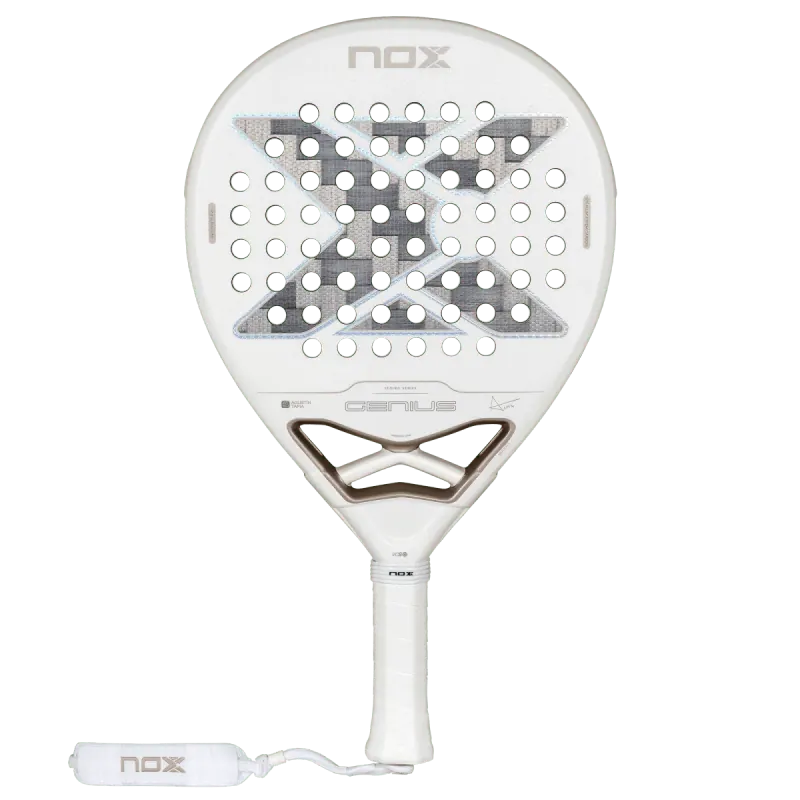
- Its main rival in the catalogue is the Nox Genius 12K: against it, it gains 27 points in comfort and gives up 47 in power.
Simulations
It spins the ball at 35 turns per second. Your víbora is going to have a mean streak.
Simulation based on specifications
Smash: back or not?Smash por 4 at 80% power and 20 °C.
Smash por 4: does it come back or not?
Raise the power, cool the court and see which racket gets it back after the glass. Raw ball exit, rebound included.
- Wilson Blade LS v4
- Wilson Blade LS v4dies in the net
Smash por 4 at 80% power and 20 °C. Wilson Blade LS v4 leaves at 109 km/h and dies in the net.
hardness according to shops
Spread: where does the ball land?20 lobs per racket, same series of shots.
Lob: where does yours land?
The same lob repeated twenty times. Each dot is a bounce at the back; the ellipse shows how much escapes your hands.
- Wilson Blade LS v4
20 lobs per racket, same series of shots. The zone where almost all the lobs of Wilson Blade LS v4 land measures 2.7 by 0.8 m.
hardness according to shops
Sweet spot: where to hit?Impact at the centre of the sweet spot: that is the reference, zero loss.
Sweet spot: what if you miss it?
Touch the racket face where you want to hit. You will see how much speed is lost on the way and how much the racket twists on the shot.
Wilson Blade LS v4 (teardrop)
Ball speed lost compared with the sweet spot
- less than 3%
- 3 to 8%
- 8 to 15%
- 15 to 25%
- more than 25%
Keyboard: focus a face and move the point with the arrows. Home returns to the sweet spot.
- Wilson Blade LS v4
Impact at the centre of the sweet spot: that is the reference, zero loss. Touch another area of the face to see how much a miss costs.
Level: how much do you use?Wilson Blade LS v4: beginner ~89%, intermediate ~90%, advanced ~58%.
Level: how much racket do you use?
Choose your level and see how much of the racket you really get out of it. A demanding racket is not better: it is only better if you can reach it.
- Wilson Blade LS v4
Wilson Blade LS v4
~90%
your swing falls right in its working zone
- Beginner: you use ~89%
- Intermediate: you use ~90%
- Advanced: you use ~58%
Using it means how much of the racket's response reaches you with your rally swing: the closer your usual speed is to the one the racket works best with, the more you use. No racket leaves a level at zero or at 100%. It is an estimate by the engine, not a measurement.
Wilson Blade LS v4: beginner ~89%, intermediate ~90%, advanced ~58%. Selected level: intermediate.
hardness according to shops
Profile: how does it compare?Profile of Wilson Blade LS v4: power 26, control 61, handling 63, ball exit 51, comfort 61, spin 78.
Racket swap: what do I gain?
Six axes, always against the same fixed scale, so a score means the same on any page. Racket 1 is the one you have; racket 2, the one tempting you.
- Wilson Blade LS v4
Wilson Blade LS v4
- Power26
- Control61
- Handling63
- Ball exit51
- Comfort61
- Spin78
Profile of Wilson Blade LS v4: power 26, control 61, handling 63, ball exit 51, comfort 61, spin 78.
hardness according to shops
Compare it with another racket
You are viewing the profile of Wilson Blade LS v4. Choose another racket to see them side by side.
What to compare with
Choose what to compare this racket with: we suggest similar rackets, or search any racket in the catalogue.
The brand prints no level for this racket. Try another option.
There are no other rackets for this option. Try another one.
Rackets with a teardrop shape, closest weight first.
Other Wilson rackets, closest weight first.
Its weight among the others
Of 232 rackets with a declared weight, 66 are in the 350 to 359 g band, where this one falls.
66 of 232 rackets declare between 350 and 359 g
Source: each manufacturer's official spec sheets, November 2026.
View data
| Weight band | Rackets |
|---|---|
| 300 to 309 g | 1 racket |
| 310 to 319 g | 0 rackets |
| 320 to 329 g | 2 rackets |
| 330 to 339 g | 1 racket |
| 340 to 349 g | 11 rackets |
| 350 to 359 g | 66 rackets |
| 360 to 369 g | 115 rackets |
| 370 to 379 g | 36 rackets |
More rackets: Wilson · Teardrop · Intermediate · Beginner
The order of the results depends only on your answers and on the data published by each brand. No sponsorship changes it.