Wilson · diamond shape
Defy Pro v1
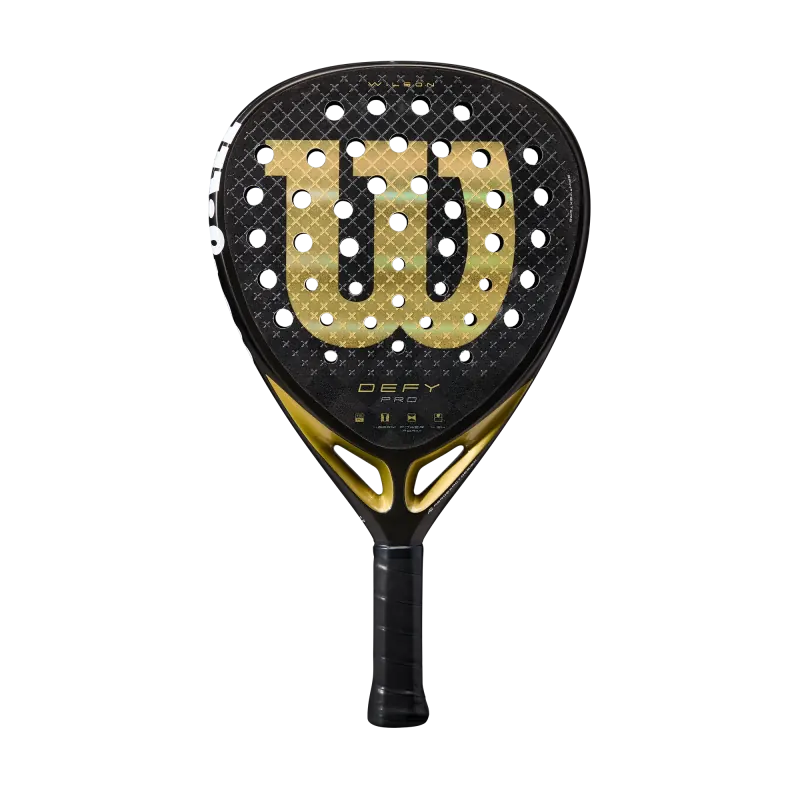
- Weight
- 370g
- Balance
- 265.0
- Shape
- Diamond
- Hardness
- Dura, Media(per store)
The dashed lines mark the sweet spot, where the ball comes off clean and with more power: on a diamond racket, high up and smaller, so it asks you to hit it centred.
Spec sheet
- Shape
- Diamond
- Weight
- 370g
- Balance
- 265.0
- Core
- Power Foam (per store)
- Face
- Carbon 15K
- Hardness
- Dura, Media (per store)
- Source: Wilson's official spec sheet, accessed on October 11, 2026
- Source: Wilson's official spec sheet, accessed on October 12, 2026
- Source of the data marked "per store": a retailer's spec sheet, accessed on October 22, 2026
- Source of the data marked "per store": a retailer's spec sheet, accessed on October 22, 2026
How to read the spec sheet
Data marked "per store" comes from a retailer's spec sheet, and data marked "estimated" is an estimate based on similar models; neither is brand data.
What neither Wilson nor a store publishes is not shown.
Beast Verdict
- Who it is for
- Diamond head: all the punch up top and a tight sweet spot, so an off-centre shot is paid for. If you have been at it for years and know the bandeja by heart, here you use ~92% of the racket.
See the full verdict
What the simulation engine says, told without a filter. Nobody has tried this racket on court to write it. (includes shop-based data)
- What it does well
- It comes out by itself: with a soft shot the ball already travels at 70 km/h, perfect for the block. It controls well: the lobs spread only 2.1 degrees and land where you send them.
- Where it struggles
- This is where it falls flat: the spin lacks spark: 31 turns per second of rotation with a swing at 80%, and the víbora comes out flat. When the match drags on, the engine feels it 9% heavier at 90 minutes.
- Who it competes with
- Its main rival in the catalogue is the Nox Genius Attack 18K: against it, it gains 30 points in handling and gives up 70 in spin.
Simulations
With a short shot it already sends the ball at 70 km/h. Lazy, but effective.
Simulation based on specifications
Smash: back or not?Smash por 4 at 80% power and 20 °C.
Smash por 4: does it come back or not?
Raise the power, cool the court and see which racket gets it back after the glass. Raw ball exit, rebound included.
- Wilson Defy Pro v1
- Wilson Defy Pro v1dies in the net
Smash por 4 at 80% power and 20 °C. Wilson Defy Pro v1 leaves at 109 km/h and dies in the net.
hardness according to shops
Spread: where does the ball land?20 lobs per racket, same series of shots.
Lob: where does yours land?
The same lob repeated twenty times. Each dot is a bounce at the back; the ellipse shows how much escapes your hands.
- Wilson Defy Pro v1
20 lobs per racket, same series of shots. The zone where almost all the lobs of Wilson Defy Pro v1 land measures 3.1 by 0.8 m.
hardness according to shops
Sweet spot: where to hit?Impact at the centre of the sweet spot: that is the reference, zero loss.
Sweet spot: what if you miss it?
Touch the racket face where you want to hit. You will see how much speed is lost on the way and how much the racket twists on the shot.
Wilson Defy Pro v1 (diamond)
Ball speed lost compared with the sweet spot
- less than 3%
- 3 to 8%
- 8 to 15%
- 15 to 25%
- more than 25%
Keyboard: focus a face and move the point with the arrows. Home returns to the sweet spot.
- Wilson Defy Pro v1
Impact at the centre of the sweet spot: that is the reference, zero loss. Touch another area of the face to see how much a miss costs.
Fatigue: heavier by the end?Wilson Defy Pro v1 weighs 370 g on the scale; its felt weight is 370 g at the start and 403 g after 90 min (+33 g).
Fatigue: how heavy at 90 min?
The arm tires and the racket becomes another racket. Drag the timeline and see how much it really weighs in your wrist.
- Wilson Defy Pro v1
- Wilson Defy Pro v1Minute 90: felt weight of 403 g
Wilson Defy Pro v1 weighs 370 g on the scale; its felt weight is 370 g at the start and 403 g after 90 min (+33 g).
Level: how much do you use?Wilson Defy Pro v1: beginner ~86%, intermediate ~92%, advanced ~61%.
Level: how much racket do you use?
Choose your level and see how much of the racket you really get out of it. A demanding racket is not better: it is only better if you can reach it.
- Wilson Defy Pro v1
Wilson Defy Pro v1
~92%
your swing falls right in its working zone
- Beginner: you use ~86%
- Intermediate: you use ~92%
- Advanced: you use ~61%
Using it means how much of the racket's response reaches you with your rally swing: the closer your usual speed is to the one the racket works best with, the more you use. No racket leaves a level at zero or at 100%. It is an estimate by the engine, not a measurement.
Wilson Defy Pro v1: beginner ~86%, intermediate ~92%, advanced ~61%. Selected level: intermediate.
hardness according to shops
Profile: how does it compare?Profile of Wilson Defy Pro v1: power 32, control 49, handling 48, ball exit 80, comfort 36, spin 15.
Racket swap: what do I gain?
Six axes, always against the same fixed scale, so a score means the same on any page. Racket 1 is the one you have; racket 2, the one tempting you.
- Wilson Defy Pro v1
Wilson Defy Pro v1
- Power32
- Control49
- Handling48
- Ball exit80
- Comfort36
- Spin15
Profile of Wilson Defy Pro v1: power 32, control 49, handling 48, ball exit 80, comfort 36, spin 15.
hardness according to shops
Compare it with another racket
You are viewing the profile of Wilson Defy Pro v1. Choose another racket to see them side by side.
What to compare with
Choose what to compare this racket with: we suggest similar rackets, or search any racket in the catalogue.
The brand prints no level for this racket. Try another option.
There are no other rackets for this option. Try another one.
Rackets with a diamond shape, closest weight first.
Other Wilson rackets, closest weight first.
Its weight among the others
Of 232 rackets with a declared weight, 36 are in the 370 to 379 g band, where this one falls.
36 of 232 rackets declare between 370 and 379 g
Source: each manufacturer's official spec sheets, November 2026.
View data
| Weight band | Rackets |
|---|---|
| 300 to 309 g | 1 racket |
| 310 to 319 g | 0 rackets |
| 320 to 329 g | 2 rackets |
| 330 to 339 g | 1 racket |
| 340 to 349 g | 11 rackets |
| 350 to 359 g | 66 rackets |
| 360 to 369 g | 115 rackets |
| 370 to 379 g | 36 rackets |